
The first time Amal Aziz wore white tie, she was watching members of the Swedish royal family hand out the Nobel Prizes one by one.
“Being in the same space where such a prestigious scientific award is being presented was a little surreal, honestly,” she says. “There was also a layer of ‘glamour’ almost that you don’t really associate with science until you see it in that setting.”
Amal, a PhD student in Biomedical Engineering at Western University, spent last December in Stockholm as Team Canada’s delegate to the Stockholm International Youth Science Seminar (SIYSS). The week of research presentations, tours and Nobel festivities brings together about 25 young scientists from around the world. It also gave Amal a permanent entry in her “two truths and a lie” arsenal.
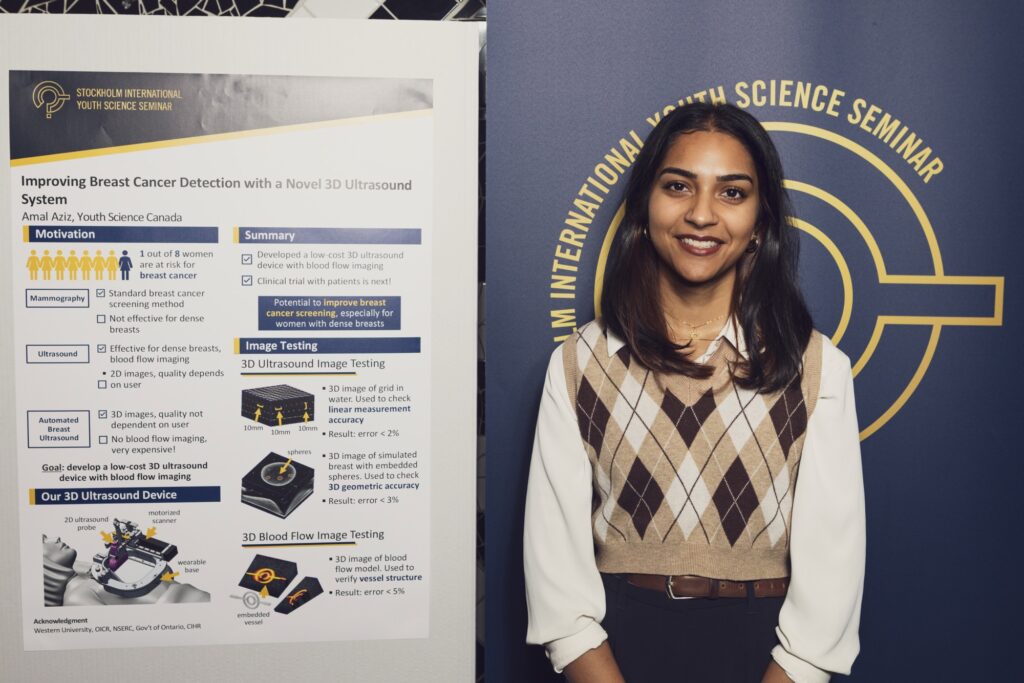
“I was a pretty shy kid”
Her friends now describe Amal as confident and a little nonchalant, though she admits she nerds out about the right topic. She wasn’t always that way. “I was a pretty shy kid and wasn’t naturally comfortable putting myself out there,” she says. “Science fair was actually one of the things that really helped me work on that.”
Getting started took persistence. In high school she found few research opportunities and no clear path to them, so much of the work was “figuring out how to get my foot in the door and finding people who were willing to give me a chance.” She went on to compete at four Canada-Wide Science Fairs, from 2016 to 2019. She still remembers her heart pounding at every awards ceremony, and three of her closest friends today are people she met there.
“I remember being so intimidated at the start, being surrounded by incredibly smart students, but then slowly as the week went on realizing that in addition to being smart, they were also cool, interesting people who wanted to be my friends, too!”
For youth, by youth
On Amal’s first trip to Sweden, the organizers surprised her first. The students running SIYSS were mostly her age, some younger, and they made a point of drawing the shyer participants in from day one. “I’m sure that the whole ‘for youth, by youth’ vibe really helped with that,” she says.
Between presentations, the delegates toured universities and companies around the city, riding what Amal considers the best public transit she has used anywhere. When she and a few American delegates got talking about letter-sized paper, Julia Trapp from Germany jumped in to explain, with real passion, why A4 is better: its sides are in a ratio of 1 to √2, so cutting a sheet in half gives you the same proportions every time.
“Honestly, the conversation wasn’t nearly as memorable as how enthusiastic she was about it,” Amal says. “I’ve probably thought about the ratio between the two edges every time I’ve encountered A4 paper since.”
“One of the panelists literally had a Nobel Prize”
At a reception the day before the Nobel ceremony, guests lined up for conversations and photos with the laureates. When the SIYSS delegates got their turn, the laureates turned the questions around. “All of them were more interested in learning about us and why we were there than talking about their own work,” Amal says.
Later in the week, she was one of four delegates asked to join a panel on getting young people into STEM, alongside a Nobel laureate in chemistry and a faculty member from a neighbouring university.
“I felt like I was massively underqualified. I mean one of the panelists literally had a Nobel Prize.” She leaned on her fellow student panellists to calm her nerves and, by her own account, got through it “without making too much of a fool of myself.”
An auditorium full of high school students
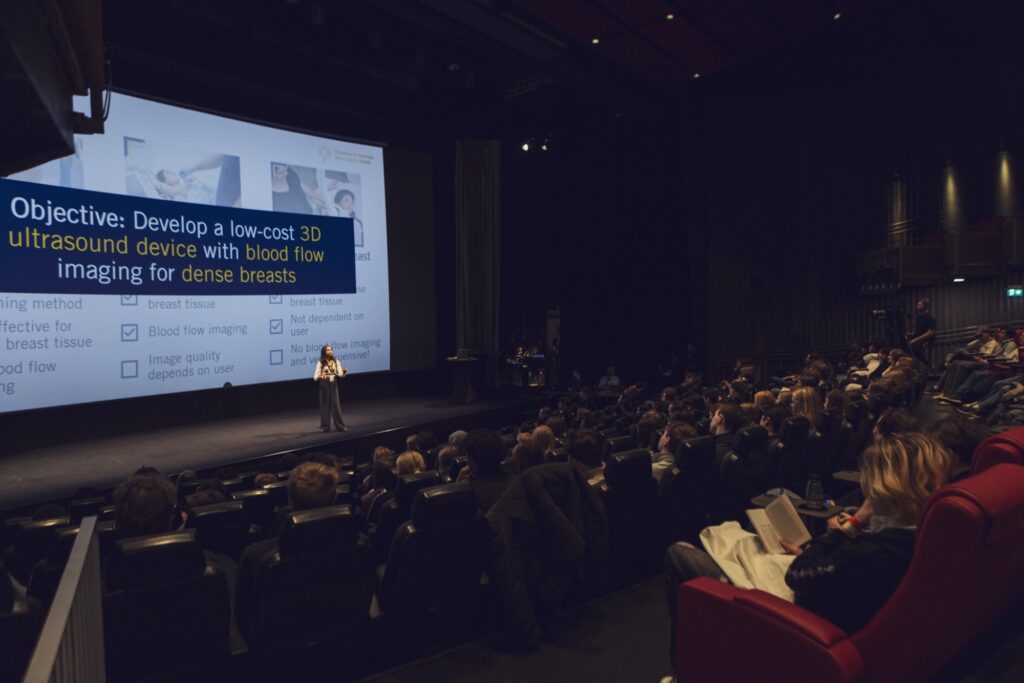
Amal is used to presenting at research conferences, where the focus is on technical detail. At SIYSS, she got mic’d up and walked on stage in front of an auditorium full of high school students. Warned in advance about her audience, she set the technical material aside and talked about the bigger picture of her breast cancer research.
Afterward, and again at the poster session, girls came up to tell her they looked up to her. Few had personal experience with breast cancer, but many knew through friends or family how stressful and intimidating treatment can be. She calls those conversations “really eye-opening.”
“Being told that my work gave them hope or was inspiring them to pursue something similar made me really proud of what I’m working on.”
“Everyone celebrates that achievement”
Amal plans to stay in medical imaging, and SIYSS widened her sense of where that could take her. Conversations in Stockholm introduced her to programs and career paths in Europe she hadn’t considered, and she has already asked about positions she’d be excited to pursue after her PhD.
“I have seen personally that professional relationships or even friendships formed at events like these can eventually turn into things like research collaborations,” she says.
For now, those relationships live in a group chat. “Every time someone meets a milestone like getting a new graduate or career position, everyone celebrates that achievement.”
Stay connected with Canada’s STEM community. The STEM Journey newsletter arrives once a month.