
Baking up a breakthrough
In grade nine, Janelle Salm had spent hours in her brother’s closet assembling a rather unconventional baking experiment in Saskatchewan. Muffin pan trays lined with yeast samples. Pieces of coloured glass rigged to different light sources. A careful, unglamorous experiment to see how different wavelengths of light affected yeast growth. She was already a baker, so naturally, curiosity about the organism she used in her kitchen arose, and she was motivated by a question she could actually test at home. The choice of her brother’s closet over her own, she notes with a laugh, was entirely intentional.
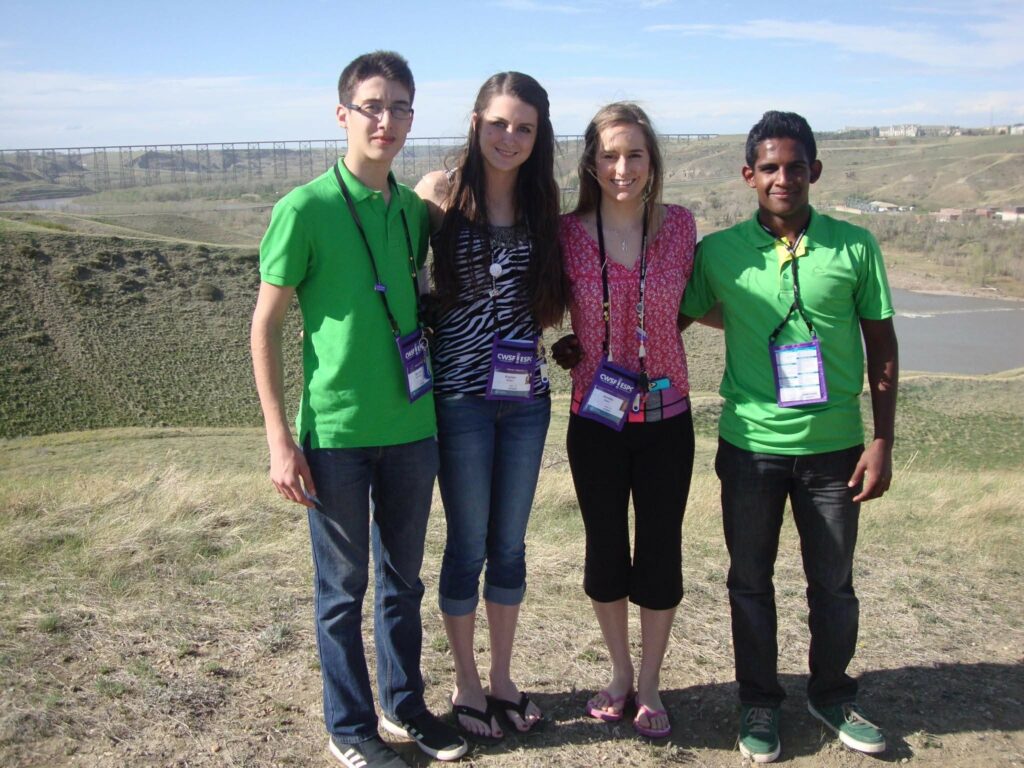
That project, improbable as it might sound, got her to the 2013 Canada-Wide Science Fair in Lethbridge.
Soft skills, hard science, and a flight to Australia
Janelle is the first to admit her project didn’t set the scientific world on fire. She remembers walking the floor at CWSF, watching students present work on fighting cancer as sixteen-year-olds, thinking: I guess not everybody is doing yeast cells in muffin tins then. What she had, she says, was commitment to the process: the method, the careful display, the ability to communicate it clearly. It was enough to get her to Lethbridge. And then something else happened.
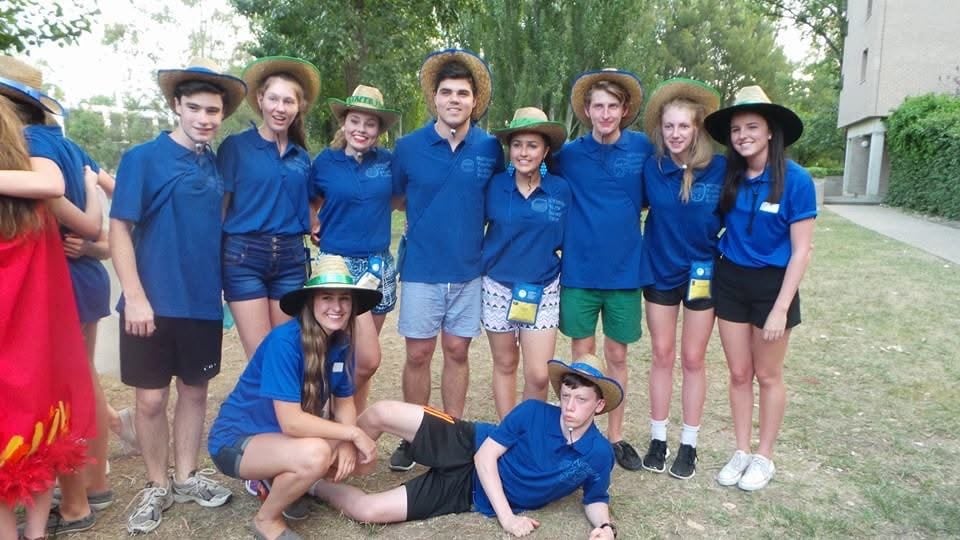
She was selected to represent Canada at the National Youth Science Forum in Australia in early 2014, alongside three other students. She suspects she might have been something of a personality hire.
“I think they basically told us that,” she laughs. “They were like, ‘I don’t know what’s going on with your project, but you can talk to people and get them excited about your project.'”
In retrospect, she recognizes the lesson in that. Communication and interpersonal skills are just as important as technical expertise. NYSF felt like CWSF on steroids: high energy, brilliant peers, the relief of finding a whole community of people who cared about the same things she did. For a kid from a small town in Saskatchewan, that mattered more than she could have anticipated.
“You’re kind of a little fish when you grow up in a small town, and you might be one of only a few people who find science cool. And then, suddenly, you’re around all these others who just get you. It’s a breath of fresh air. There’s a whole world for us out here.”
Numbers ruling the world
Janelle came back from Australia with a broader sense of what was possible and a pragmatic streak that had been there since grade twelve. A good business teacher had pulled her into case competitions and given her an early instinct that numbers, for better or worse, tend to rule the world. She went to UBC for accounting, joined KPMG, and built a foundation in finance and data analytics that would later prove very useful. The love of STEM was always there.
At KPMG, she drifted toward the sustainability committee as an extracurricular and found herself spending time with people in the ESG division she admired. Internal advocacy, DIY beeswax wraps, and a growing conviction that she wanted to drive real change at companies with real footprints eventually pulled her toward sustainability consulting. About a year and a half ago, she moved into her current role as ESG Controller at Mercer, a global forestry company with pulp mills, sawmills, and mass timber facilities across British Columbia.
The complexity of a pulp mill was intimidating at first.
“I was like, these are big chemistry units. I’m really going to have to go back into actual science knowledge.”
Big chemistry units and biogenic carbon
The ESG Controller title is new enough that Janelle often finds herself explaining it from scratch: it does what a financial controller does for a company’s finances, but for environmental and social data instead. She ensures metrics are measured correctly, oversees greenhouse gas emissions reporting, and leads Mercer’s decarbonization planning across its global operations. One of her biggest projects over the past year has been figuring out how to measure carbon stored in living forests: a problem that sounds straightforward until you realize how difficult it is to do accurately at any meaningful scale. She recently completed a micro-certificate in forest carbon modelling at UBC to better understand the underlying science.
One of her favourite moments on the job came from conversations with workers at the company’s rural pulp mills. When you asked them, they’d say they hadn’t done anything related to sustainability. Then, with a little conversation, it would come out that they’d quietly reduced water use, cut energy consumption, and improved chemical recovery rates over the years, saying, “that’s just good business practice.” They might not have used the sustainability jargon, but that didn’t stop the work from already happening.
“It turns out that’s the thing,” she says. “There are a lot of buzzwords, but at the end of the day, we’re already doing it.”
She sees this as one of the clearest lessons she carries from science fair to her work: you often don’t need to change what people are doing; you need to help them understand that what they’re doing connects to something bigger.
One step in front of the other
Janelle is thinking more about teaching these days. She’d like to teach part-time while staying in the field. Policy interests her too, drawn to the space where economic realities and climate science must be weighed together, where her accounting background and her scientific instincts might both find a use. She doesn’t have a destination mapped out.
What science fair gave her, she says, is less about the specifics of yeast or light wavelengths and more about a way of approaching the world: constant learning, comfort with uncertainty, the understanding that the data will never be perfect and the methodology will always have limitations, and that you do the most rigorous work you can and let the next person build from there.
“You just keep going. The alternative is we do nothing, which doesn’t feel like an option to me.”
Not bad for a project that started with muffin tins and coloured glass in her brother’s closet.
Stay connected with Canada’s STEM community; The STEM Journey newsletter arrives once a month. Subscribe here.