
Chuck Buckley has been watching students walk up to a science fair display board for more than four decades. He has coached them, judged them, organized the fairs they compete in, and advocated for the value of the work they do, all while building a 40-year career as a petroleum geoscientist in Calgary. But when you ask him why he has devoted so much of his life to science fairs, he keeps returning to the same thing: not the projects, not the awards, not the institutional milestones. The students who find their people there.
“They found a place where they belong,” he says of the youth he has come to know over the years. “That’s important. Because otherwise, they go off and – I don’t know. [Through STEM projects] they can reach their ultimate potential because they feel they belong.”
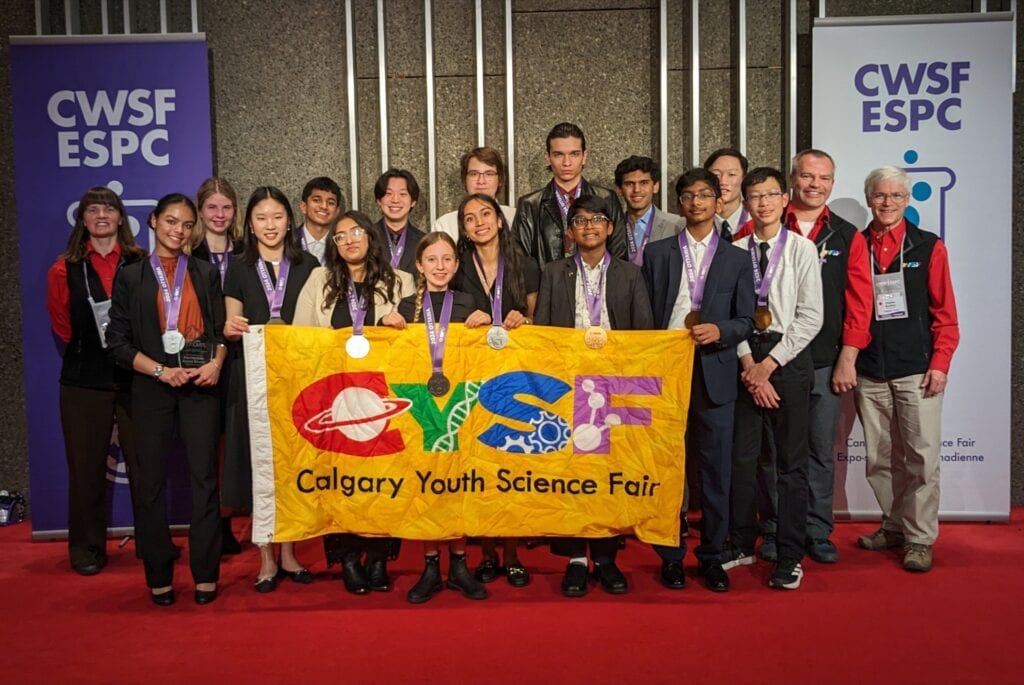
Photo courtesy of the Calgary Youth Science Fair.
His father brought the science fair idea across the border
Chuck grew up in Sarnia, Ontario, a city with an unusually high concentration of professional scientists and engineers. Dow, Shell, Imperial Oil, Polysar, Dupont: the refineries lined the waterfront, and the people who worked for them were the fabric of the community. Chuck’s father was part of the small group that brought the science fair concept across the border from Michigan. In the Buckley household, it was simply part of how the world worked.
He did a project or two in high school, then left for the University of Waterloo to study Earth Sciences. The co-op program sent him to work placements across the country. In retrospect, those experiences taught him how to arrive in unfamiliar places, find a way to contribute, and return with a clearer sense of his own abilities. He now realizes that is exactly what science fairs do for young people.
After graduating, he chose petroleum over mining. The industry was booming. He built a 40-year career in Calgary, and almost immediately started judging at the Calgary Youth Science Fair. That was 1981.
Directing traffic, focusing people
Chuck judged for years, took brief breaks when his children were young, and, in 2002, was invited to join the organizing committee when Calgary was selected to host the 2003 Canada-Wide Science Fair (CWSF). He attended Saskatoon 2002 to shadow operations, then served as co-manager of facilities for the Calgary event the following year.
He moved through the formal leadership structure of the Calgary Youth Science Fair Society, serving as vice president, president, and past president. Due to a mid-term resignation, he served as president again. He has attended Canada-Wide Fairs as a delegate or alternate delegate 9 times over his career. He is thankful for the strong foundation built by those who have gone before us.
The president’s role, he explains, is less about doing the operational work than holding the organization together. “Directing traffic and focusing people,” is how he puts it. The committees are where the real work happens, and he has never really left them.
Who Killed Banana
Much of Chuck’s energy over the years has gone into training judges, specifically helping them understand that scientific excellence has nothing to do with a topic’s sophistication.
“A volcano project or some other growing plants project can do just as well as the one out of a research lab at the University of Calgary, if it is done very, very well.”
He trains judges to use Calgary’s tally sheet and rubric, adapted from the CWSF version, and to ask questions appropriate to the complexity before them.
Last year, a young student won the Calgary Youth Science Fair with a project called “Who Killed Banana,” a DNA extraction study. It was not the most technically intricate entry at the fair. “What was amazing about her project was that everybody got engaged and could understand it.” She went to CWSF and did well in the junior division. “The point was that she learned a tremendous amount about science, applied the scientific method, and communicated it well.”
Communication is almost always the point for Chuck. He coaches Calgary’s students heading to the Canada-Wide Science Fair, and a recurring focus is helping them present their work without underselling or overclaiming it. He thinks of a student from a recent fair presenting an idea still in early development, one who needed coaching away from presenting it as a proven solution. “We coached her to not come in as if she’d solved the world, but to come in with an exciting potential solution, something that had a really interesting potential avenue to develop.”
The distinction matters to him beyond the tactical. Bad science, he says simply, is claiming too much.
The second year nobody notices
His most-repeated piece of advice is counterintuitive in a culture that rewards annual competition cycles: sometimes, you should not enter.
He points to Emily Cooley, who won the Canada-Wide Science Fair at Trent University in Peterborough. Emily had spent a full year developing her knowledge in the advanced subject matter of her future project before competing. A first year of learning and exploring, a second year of defining her own problem and refining her project. The result was what Chuck describes as “over the top” project quality.
“I really do feel that second year on a project usually gets a short shift,” he says. Most students enter too soon, with ideas still finding their shape. The students willing to sit with the work longer and to ask questions before rushing to an answer often end up with something genuinely stronger.
“We’re just at the beginning”
Chuck is not nostalgic about the current landscape. He is clear-eyed about the pressures: robotics programs competing for teacher attention, private schools dominating through curriculum integration. Calgary’s participation maximum has remained unchanged since the late 1980s, while the city’s population has doubled. He is watching closely as AI creates new challenges for evaluating authentic student work, convinced that in-person judging is the only real answer. “The in-person interrogation is really the only way to get around challenges of not giving credit for some of the support you’ve had along the way,” he says.
But he is genuinely optimistic about what the current generation can do. He sees young scientists using programming and computational tools in ways that would have been unimaginable when he was in university: accelerating research, testing more hypotheses, and thinking faster.
“The promise of computerization is real for accelerating human knowledge for the benefit of all humankind,” he says. “We’re just at the beginning.”
The legacy he cares about is not his own name on anything. It is the Calgary Youth Science Fair organization and the broader Youth Science Canada network that continue to be strong enough to provide a community where students discover that they belong, and where people recognize their capabilities.
“They can reach their ultimate potential because they feel they belong.”
He has been betting on that idea for more than forty years. He is not done yet.
Inspired by Chuck’s story? There are many ways to support Canada’s next generation of curious minds, from judging at your local science fair to joining a regional organizing committee. Find your way to get involved.