
From a basement lab to the world stage
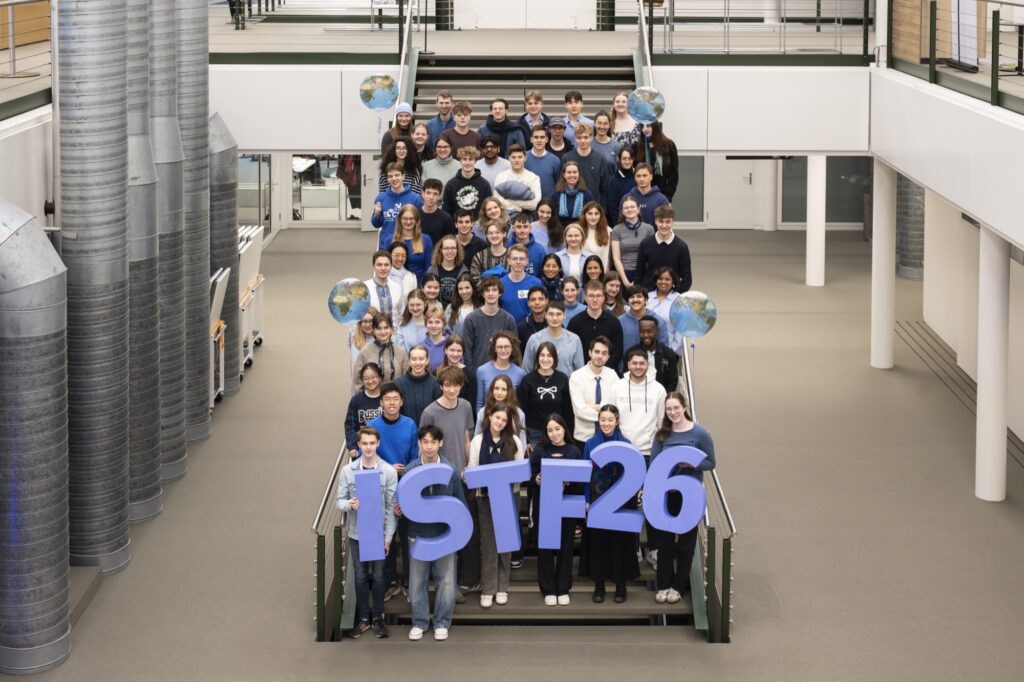
Annabelle Rayson had a short layover at the train station in Bern. She was travelling from Zurich to Murten, a small lakeside town in western Switzerland, to represent Canada at the International Swiss Talent Forum (ISTF). On the platform, she met several other participants heading the same way. Instead of waiting for the next train, the group spent the next two hours exploring Bern together.
“Everyone was deeply curious about each other’s backgrounds and interests in science and engineering, and each other’s cultural traditions,” she says. “It was a fantastic start to the trip.”
ISTF 2026 was Annabelle’s fourth international event with Team Canada.
Like a little Pac-Man
Annabelle grew up in Sarnia, Ontario, surrounded by the Great Lakes. Her mother taught biology at the high school and college level, and her father is a commercial fisherman. Some parts of Lake Erie where he once fished are now off limits because of harmful algal blooms. These algal overgrowths release toxins, and as they decompose, they strip the water of oxygen and leave dead zones behind.
The main treatment, algaecides, kills the algae along with everything else in the lake. Annabelle wanted a natural alternative. She found one in Daphnia magna, a tiny freshwater zooplankton she describes as “like a little Pac-Man” that eats up the algae before it can decompose.
She had been entering the Lambton County Science Fair since Grade 4. When the pandemic closed schools in 2020, she set herself a challenge. “I remember going into lockdown and I’m like, I’m going to find an awesome science fair project idea. I’m not leaving lockdown until I have it.”
Her rule is never to start a project without at least four months of pure research. She read scientific literature, emailed her local conservation authority, talked with her father and other fishers about how the blooms affected them, and cold-emailed researchers with questions. One introduction led to the next. Evolutionary biologists at the University of Guelph supplied her Daphnia genotypes. Nautilus Environmental, a lab in Sarnia, provided algae to feed her cultures and fielded her calls when something went wrong. Lambton College lent her a hemocytometer to count algae cells. The experiments themselves were entirely her own.
“Don’t be afraid to reach out to those professionals and professors, because they were once in your exact shoes.”
My little basement limnology lab
She raised her Daphnia in a homemade lab in the family basement. Her project, Plankton Wars, compared genotypes of Daphnia magna to find the one best suited to controlling algal blooms, then tested it against nutrient pollution, plastic pollution and varying levels of algal toxicity. It took five experiments and 195 tests, each experiment running for two weeks. She woke at 4 a.m. to feed her Daphnia and run tests, and spent one Thanksgiving counting cells of toxic Microcystis in the family kitchen.
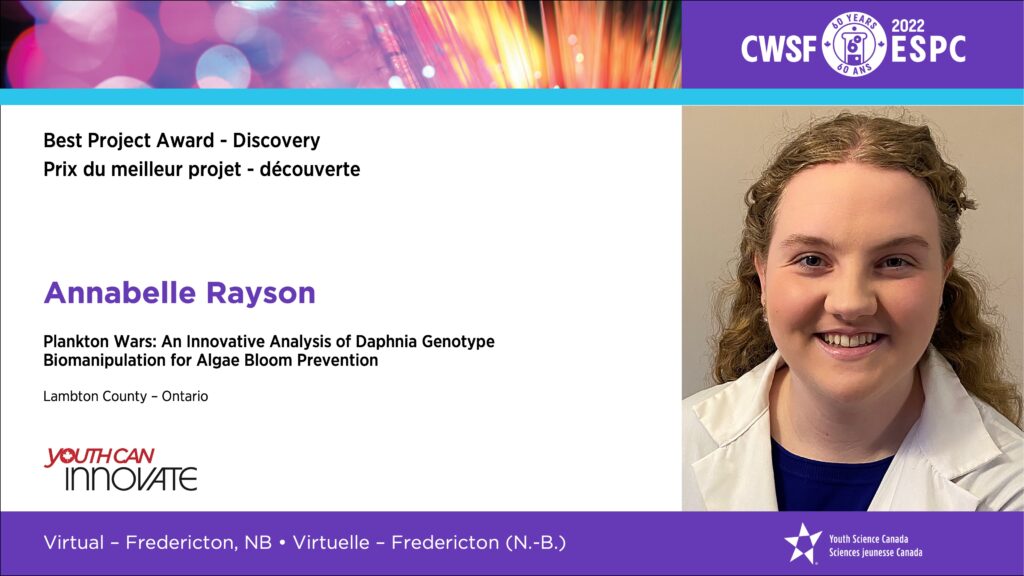
It was her third Canada-Wide Science Fair. She had won bronze at her first, in Grade 8, and silver at her second. In 2022, watching the virtual awards ceremony from home, she noticed the senior Best Project Award hadn’t been announced yet. Then her phone lit up with messages from friends who had a faster internet connection. Her name was on the screen, surrounded by confetti. She and her mom ended up hugging and crying on the floor for 20 minutes.
“The fight against harmful algal blooms has begun”
At her first CWSF, Annabelle had watched the finalists for the Canadian Stockholm Junior Water Prize get called up on stage and decided she would be up there one day. In 2022, after her project won the Canadian Stockholm Junior Water Prize at CWSF, she got the call: she would represent Canada in Stockholm.
At the awards gala in August, after meeting the Crown Princess of Sweden, she listened as the head of the jury described the winning project. “The fight against harmful algal blooms has begun,” the jury chair said. “There are other people who studied algae,” she remembers thinking. “Can’t be me. Would never be me in a million years.” Then the jury announced Canada. She sprinted across the room in her gala dress to hug her mom and her national organizer before heading up on stage to accept the 2022 Stockholm Junior Water Prize, the top international honour in youth water science.
A week into Grade 12, she was in Leiden in the Netherlands for the European Union Contest for Young Scientists. On public day, local elementary schools toured the hall, and she found herself explaining zooplankton biomanipulation “to a six-year-old Dutch child in broken Dutch.” She came home with third prize, and the following spring she competed at the Regeneron International Science and Engineering Fair in Dallas.
No projects, just water
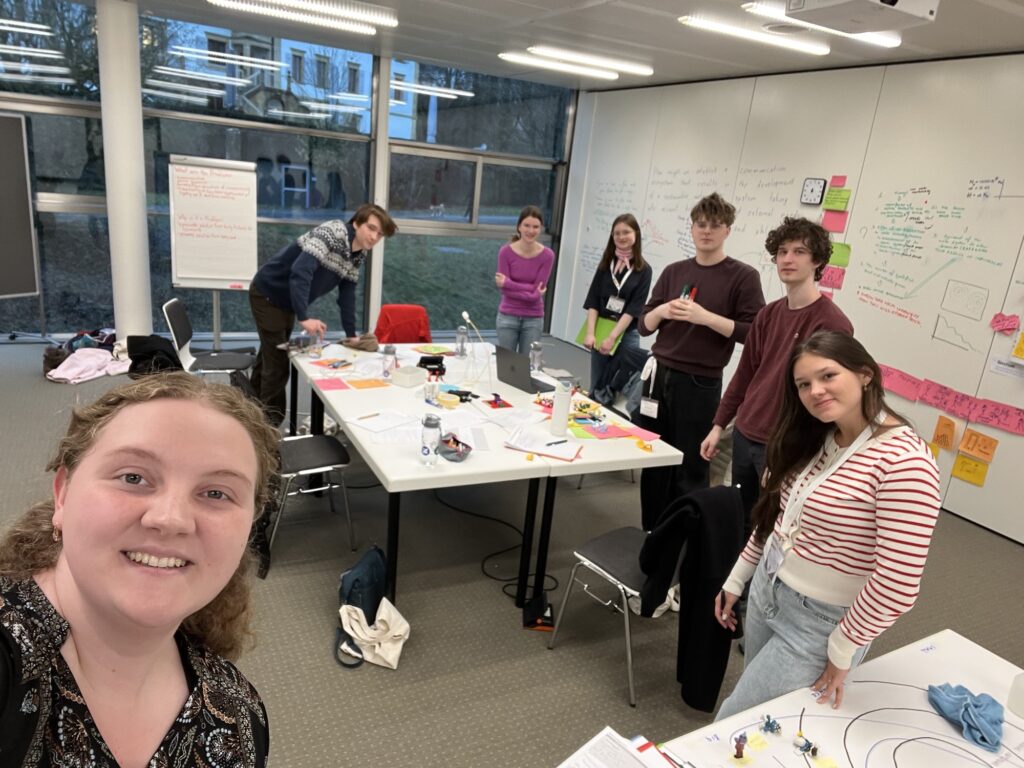
Fast-forward to 2026: at ISTF, nobody brought a project. The forum is a think tank, and participants spent the week on a single theme, water, learning from keynote speakers, from organizations working on water challenges, and from each other. Annabelle especially valued learning how Brazil and Hungary manage water in the face of drought and agricultural challenges.
The highlight was Swiss culture night, with a local yodelling troupe, potato rösti, local cheeses and mushroom stew, followed by dancing to Swiss music late into the evening.
The biggest surprise was the event’s focus on the non-profit and international development side of water management. “As a university student who does most of the science I do in a classroom or a university-run lab, I have not often thought about these spaces and their connections to lab science and research,” she says. ISTF had her thinking about how the two could benefit each other. She also came home proud of how much her communication skills had grown across international barriers.
It all started with curiosity
The experience confirmed her plans to study and work in the water sector. “I learned about many different pathways and opportunities within the water industry, and about pressing global water challenges that made me deeply curious and determined to work in and solve,” she says.
She believes Canada should keep sending students abroad, both for what they learn from international peers and for what they show the world. “It is a way for Canada to showcase youth innovation and present the incredible work of our students on the world stage.”
Back in 2022, she told us on the Why to How podcast that the 4 a.m. alarms never felt like a chore because she cared so much about the topic. “If it’s something that genuinely excites you, you will never lose motivation.”
“Don’t lose your curiosity. That is your superpower.”
Stockholm, Leiden, Dallas and Murten each left Annabelle with friends she expects to keep for life.
“These events all inspired me to pursue STEM and have truly changed my life,” she says. “And it all started with curiosity and a homemade basement lab in rural Ontario.”
Stay connected with Canada’s STEM community. The STEM Journey newsletter arrives once a month.