
Aaron Judah won Best Project at CWSF 2000. Twenty-five years later, he came back to Fredericton as a volunteer judge and discovered the experience was just as transformative the second time around.
“It starts with you, it becomes about us, and then it becomes about those that come afterwards.” Aaron Judah leans forward as he shares this philosophy, learned during his years serving in the Canadian Armed Forces. It’s the same cycle, he explains, that brought him back to the Canada-Wide Science Fair after a quarter century away.
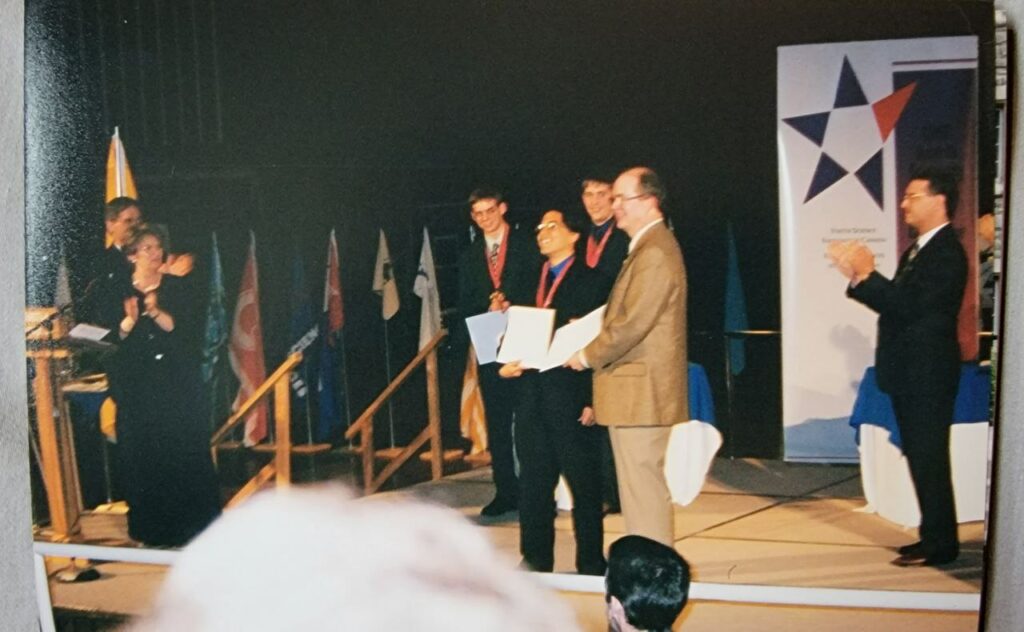
Aaron’s STEM fair journey began in ninth grade with a project measuring how heat transferred through pieces of metal. “It was my science baby at the time,” he laughs. That first project launched a trajectory that would take him through multiple CWSFs, to the International Science and Engineering Fair, and ultimately to winning Best Project at CWSF 2000 for his project on Sonoluminescence.
“Being brought to the stage in front of everyone with all the flashbulbs, that was a big moment for me,” he recalls. “Even to this day, it still is.”
A winding path
The career path Aaron envisioned at eighteen didn’t unfold quite as planned. “I thought I was going to get my PhD in nuclear physics and then do fusion research and have that all done by the time I was 26,” he says with a rueful smile. Reality had other ideas.
After studying physics at Western University, Aaron worked in technical analysis for a Fortune 100 company before starting a PhD program at Yale University. Then a “middle-class identity crisis” hit, and he joined the Canadian Armed Forces, serving full-time for almost eight years. Along the way, he completed his doctorate in space science and applied mathematics, not nuclear physics.
Today, Aaron is the Manager of Primary Nuclear Systems at Darlington Nuclear Generating Station, one of Canada’s largest nuclear facilities – Darlington Nuclear is highly ranked and is considered a world-leading nuclear plant by the World Association of Nuclear Operators. “I help keep the lights on,” he says simply. It’s a long way from that ninth-grade project on thermal conductivity, yet the connection is evident in hindsight: the same curiosity that drove a teenager to buy thermistors at the electronics store now powers his work ensuring nuclear safety.
Looking back, Aaron wouldn’t change a thing, even the detours he never saw coming. “I don’t think I ever wake up in the morning and regret the decisions I have made,” he reflects. “The journey is really important.”
Finding his community
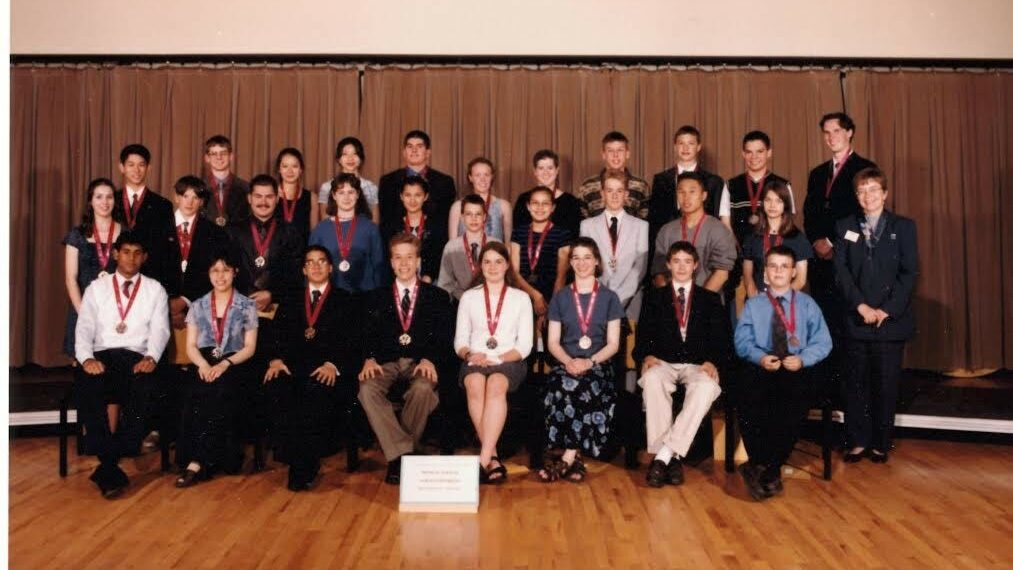
When asked what he values most from his CWSF experiences, Aaron is quick to answer: the friendships. “My last Canada-Wide Science Fair was 25 years ago, and I still keep in touch with people that I met there,” he says. “…I was quite literally talking to a friend of mine yesterday, who I met during the science fair.”
And these aren’t just nostalgic connections. “Now that we’re all grown up and we’re professionals, we’ve bounced ideas off each other more than once. We’ve collaborated on a few things here or there, and I really value those experiences.”
“The friendships that I took away from the science fair are probably the most valuable things from those experiences,” he reflects. “Some of the best people I’ve ever met in my entire life are my best friends. And those are the people that I met on that journey.”
Coming full circle
So why return as a judge after all these years? For Aaron, it was partly about the milestone: 25 years, almost to the day, since his Best Project win. But it ran deeper than nostalgia.
“I kind of felt a little guilty because…I haven’t really tried to help out after all these years – I’ve just been so busy with everything,” he admits. “And then you think about it, it’s like, you know what, I should send an email or make some calls and see how people are doing and see if I can, at the bare minimum, just come over and say hi and help judge a few projects.”
What he found on the other side of the judging table was unexpectedly moving and a little disorienting.
“It’s a little sobering,” Aaron admits. “In some moments of reflection, I think to myself, geez, what was going through my head when I was 15, 16 years old?” Standing where the judges once stood, he found himself thinking about the adults who had evaluated his projects all those years ago and what they must have seen in him. “It kind of gives me flashbacks,” he says. “Looking around here, it’s like, oh my God, what was I thinking when I was 15 years old? I didn’t know anything, and I thought I had it all figured out.”
The experience brought what Aaron describes as “a lot of mixed emotions”: nostalgia, perspective, and occasional moments where he had to remind himself he was talking to teenagers. The calibre of work on display made that easy to forget. “In some ways, I have to hold back,” he explains, “…I’ve gone through a few things in my technical development as a scientist and engineer. Realizing that you are dealing with high school students means at times you need to be tempered.”
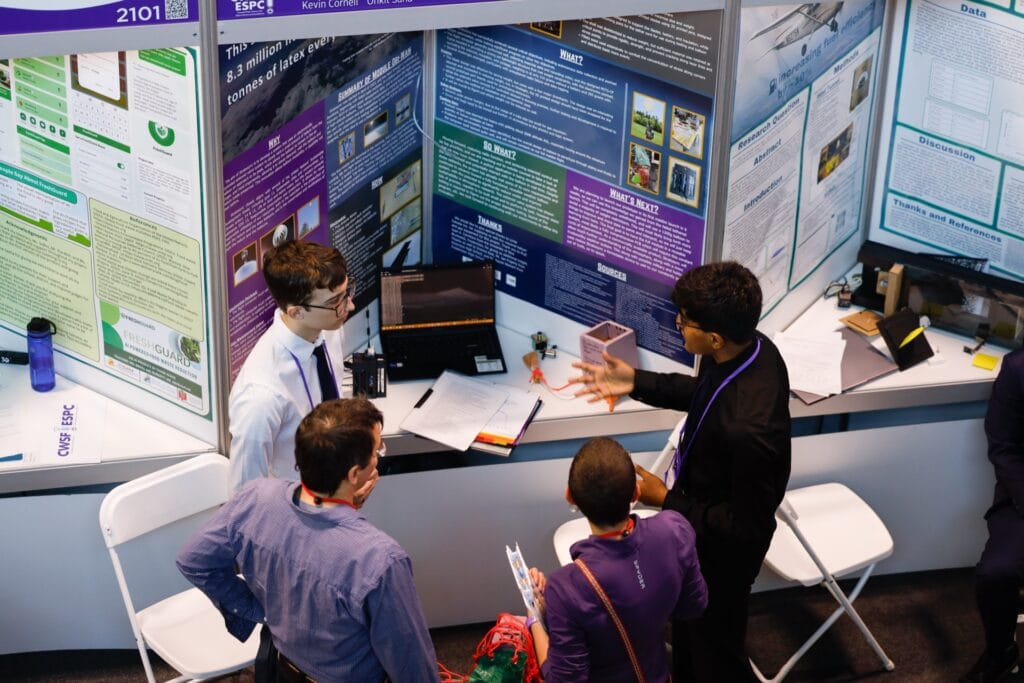
But that’s precisely what made the experience so inspiring. “I had one experience where I was judging this one project, and I asked the student a number of questions, and the student was able to walk with me, through a thought process I would have followed,” he recalls. “It was very, very inspiring. It was one of those oh wow moments – you’re seeing what I’m hoping you’re seeing. Give many of these students ten years, and they’re going to be outstanding at anything they do.”
What judges really look for
Aaron’s approach to evaluating projects reflects his years of professional experience. He doesn’t expect high school students to produce work worthy of a scientific journal cover, but he does look for something equally important.
“At the very, very highest level, if they’ve done a literature search…, not at a doctoral thesis level, but if they’ve made a concerted effort and they’ve come up with some ideas that are inspired by it, that is kind of what I’m looking for,” he explains.
He has a particular soft spot for students who replicate known experiments but execute them exceptionally well. “Even at the graduate school level, you will find people, even top-level graduate students, who still can’t do that,” he notes. “It’s hard to be able to push innovation and discovery if you can’t do the bare bones basics of a proper scientific experiment: controlling variables, identifying new variables, and reducing or eliminating errors and uncertainties.”
When it comes to communication, Aaron sees projects as a form of storytelling. “Your project is a story,” he says. “I try to see the story that they’re trying to tell in that project. Then, mapping it to the individual, to see what story they want to tell me. If the project tells a good story, and if they can tell a good story, that tells me that they really understand what they’re doing.”
His advice to finalists wanting to make an impression? “Think about what your big highlight is and think about your journey to get to that highlight or insight. Part of that journey is your development, and also part of your experimentation or investigation.”
The professional stakes
For Aaron, volunteer judging isn’t disconnected from his day job; it’s intimately connected to it. As someone who hires and develops engineers and scientists in the nuclear industry, he sees CWSF as part of the pipeline that produces Canada’s future STEM workforce.
He’s candid about what concerns him in that pipeline. “I do see the advent of AI with projects, and this is a big departure,” he observes. While he recognizes the potential of artificial intelligence (his doctoral thesis was on advanced regression algorithms), he worries that students make blanket statements like “I will use AI to improve that” without substantiating their claims.
“At least when I hear those statements and I probe into them, I don’t find a lot of substance,” he says. “And that I do find very concerning.”
This concern extends directly to his professional life. “In my regular work, I certainly see that with the incoming scientists and engineers in my organization and those that I hire,” he explains. “When people’s lives are at stake, if you’re designing a bridge, designing a filter for toxic chemicals, those types of things, we need the best. It can’t be a half measure. It has to be 100%.”
So, what should we do? “When I look at new hires in my industry (nuclear), I keep them on a tight leash, as do all of my peers. And the evaluation period for them we’re probably going to be extending because we need to make sure that the people that we hire are actually of the right calibre and can adapt to the excellence standards we hold ourselves to.”
For Aaron, judging at CWSF is a chance to engage with this challenge at its source, encouraging rigorous thinking and authentic scientific work in students before they enter the professional world.
Reasons for optimism
Despite his concerns about AI misuse, Aaron is genuinely excited about the next generation of scientists and engineers. “This incoming generation of scientists and engineers, they’re better connected to the world than even my generation ever was,” he says.
He remembers when the internet was just beginning to blossom during his high school years, enabling him to communicate with people across the globe. “Now this generation is even more connected. They’re more socially aware of a lot of things, which is good in many ways.”
He believes the tools available today will allow young scientists to push the boundaries of knowledge faster than previous generations. “There are apps where you can throw a hundred papers at it, and it can give you a high-level summary, and then you can figure out which papers you really, really want to read,” he notes. “I think with this generation, the fact that they’re more connected, they’re more socially aware, and they have better tools, they’re going to be able to push boundaries of knowledge and technology quicker than the previous generations.”
This is precisely why events like CWSF matter, Aaron argues. “I also want to reinforce that the things that we do here in STEM are really important. They help protect our society, help grow and close the gap in inequality.”
In a world where young people are increasingly drawn to careers as social media influencers, Aaron sees science fairs as a vital counterbalance. “We need to celebrate and also encourage people to pursue these types of careers and fields,” he says. “Being a cool influencer or a super athlete, again, there’s a place for it. But I’d like to believe that someone like myself and my peers also help contribute to society, and I want more people to come into our ranks because there is a need for that.”
The cycle continues
Aaron sees volunteer judging as completing a cycle essential to society and to his own sense of purpose.
“When you’re at CWSF as a finalist, it starts with you, because you need to learn all of this stuff as a student, and you need to get good at it. So, work on your project, have fun, ask lots of questions and grow as an individual and as a young scientist.”
The second phase, he explains, is about collaboration: “Once you’ve gotten your educational credentials and you’ve grown as a scientist, I need folks like that to come with me to do work and to help push the boundaries of knowledge.” In the nuclear industry’s current growth phase, Aaron is actively seeking the best people to ensure the work continues.
The final phase, the one that brought Aaron back to Fredericton, is about giving forward. “I’ve benefited a lot from the people who helped me out, and I will forever be grateful for that. Now I feel indebted to not just them, but to our youth and our society to help give back.”
His hope is that other STEM professionals will see judging the same way: “Becoming part of that cycle of development to help and inspire the next generation so that they understand what they need to do down the road and how to give back.”
Join the cycle
To those considering volunteering as a CWSF judge, Aaron offers a simple message: you’ll get more than you give.
“There’s very special satisfaction that at least I get from being able to help out the next generation,” he says. The experience brought him nostalgia, perspective, and unexpected inspiration, as he watched students demonstrate the same rigorous thinking he uses in his professional work.
And to the students themselves, whether they win medals or not, Aaron has one piece of advice: “Enjoy the ride. The journey is more important than the destination.”
It’s advice he wishes someone had given his younger self, standing at that science fair 25 years ago with his project on Sonoluminescence. Back then, he thought he had his whole life mapped out. He was wrong about the specifics but right about what mattered.
“The world is a complicated place, especially right now,” Aaron acknowledges. “But at the same time, that’s all the more reason why we need more people like them to grow and succeed.”
The 2026 Canada-Wide Science Fair will be held in Edmonton from May 23–30 at the Edmonton EXPO Centre and the University of Alberta. Learn more at cwsf-espc.ca