
Canadian students win first and second prizes at European Union contest for young scientists
Gurnoor Kaur of Waterloo, Ont., and Liam Desré of Kingston, Ont., win in Germany for research on blood oxygen sensors and the expansion of the universe.
Ottawa, September 29, 2026 – Youth Science Canada recognizes the incredible successes of Gurnoor Kaur, a Waterloo, Ont., Grade 12 student and Liam Desré, a Grade 10 student from Kingston, Ont., who won top honours at the 37th European Union Contest for Young Scientists (EUCYS), held September 22 to 27, 2026, in Kiel, Germany. The two Canadian students presented their STEM projects alongside 140 young researchers from nearly 40 countries. This marks the fifth consecutive year that Canada has won two EUCYS Core Prizes, an achievement unmatched by any other country over that period.
Gurnoor Kaur won one of four first prizes, worth €7,000, for EigenPulse: Eliminating Demographic Bias in Pulse Oximetry and Remote PPG from First Principles. Kaur’s research identified how the interaction of light with skin can introduce bias into both pulse oximeters and camera-based remote photoplethysmography (PPG) and developed methods to correct it. Kaur traced the problem to the underlying physics of how these technologies interpret light passing through and reflecting from tissue, and developed approaches designed to make measurements more accurate across skin tones.
Desré won one of four second prizes, worth €5,000, for ΛCDM+S: Evaluating a Thermodynamic Extension to Standard Cosmology. Desré developed and tested a thermodynamic extension to ΛCDM, using simulations to investigate whether entropy-related effects could instead account for the observed acceleration. His work produced a model that can reproduce key features of the universe’s expansion without requiring dark energy, providing a testable alternative for further investigation.
“Every year since 2022, Canadian students have brought home two Core Prizes from EUCYS, with projects spanning remarkably diverse fields from CAR-T cell therapy and asteroid detection to a robotic sea turtle and, this year, medical sensing and cosmology,” said Reni Barlow, executive director of Youth Science Canada. “Behind that success is a national network of regional STEM fairs, teachers and volunteers who help young people develop their ideas and advance from their local and regional communities to the Canada-Wide Science Fair, and for some, onto the international stage. We’re incredibly proud of Gurnoor and Liam and what they have accomplished in Kiel.”
Both students earned their places on Team Canada through their outstanding performances at the 2026 Canada-Wide Science Fair in Edmonton in May. Kaur received the Best Project – Innovation award, while Desré received the Best Project – Discovery award. Their results in Kiel continue Canada’s strong record at the European competition.
Youth Science Canada coordinates Team Canada delegations representing the country at international youth STEM project competitions. Team Canada’s participation is made possible through the generous support of Youth Can Innovate, a program of the Gwyn Morgan and Patricia Trottier Foundation.
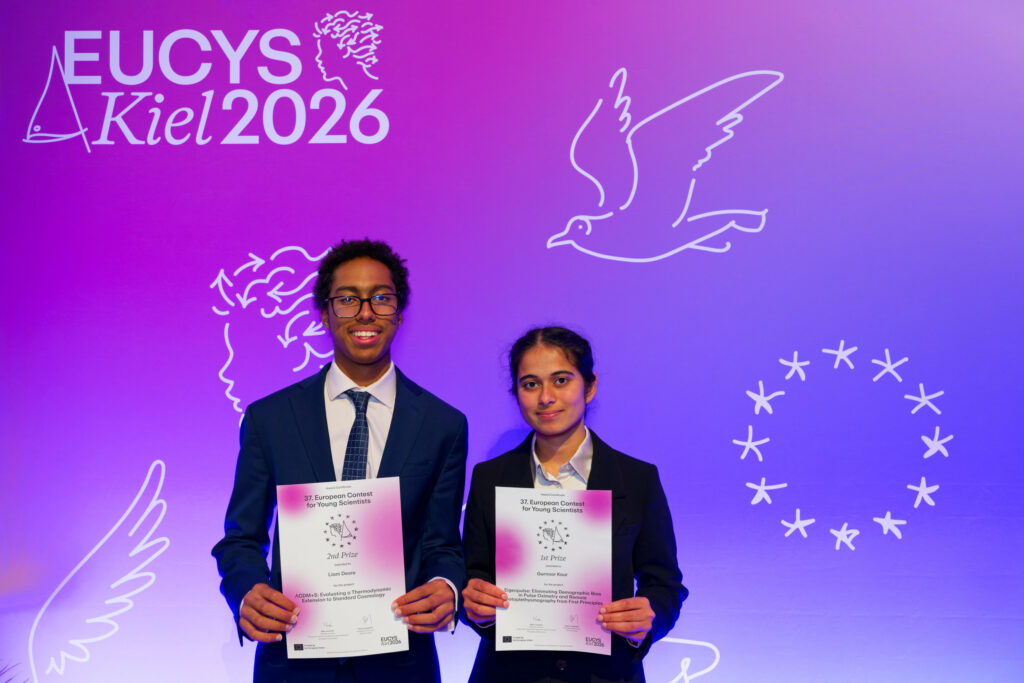
CWSF alums Liam Desré (left) and Gurnoor Kaur (right) proudly display their core prize awards at the European Union Contest for Young Scientists held September 22-27, 2026, in Kiel, Germany.
– 30 –
About Youth Science Canada
Youth Science Canada empowers all Canadian youth to engage their curiosity in discovering and innovating through STEM projects. A registered charity incorporated in 1966, YSC delivers on its mission through national programs, including mySTEMspace, the National STEM Fair Network, Canada-Wide Science Fair, STEM Expo, Team Canada representation at international fairs and Smarter Science professional development for teachers. Through these programs, YSC supports the more than 500,000 students who do STEM projects in any given year. For more information, visit youthscience.ca.
About the European Union Contest for Young Scientists
The European Union Contest for Young Scientists was set up by the European Commission in 1989 to encourage cooperation and exchange between young scientists and to give them an opportunity to be guided by some of Europe’s most prominent researchers. Every year, the event gathers promising young scientists from all over Europe and beyond to present their projects to a panel of international judges. Only projects that have won a first prize at a national science competition are invited to participate in EUCYS.
For more information:
Dalia Esposito
Torchia Communications
[email protected]
Cell: 514-654-2635