
In the spring of 1983, nine students carried their projects into a small building on Granville Street in Vancouver. There were no sponsors lined up, no provincial funding waiting in the wings. Just nine kids, their curiosity, and a former teacher who had decided to say yes when most people might have walked away.
By the following year, participation had doubled. By year three, they had outgrown the space entirely. Over the next four decades, what began in that small room would grow into the largest volunteer outreach network supporting STEM learning in British Columbia.
It all started in 1982, when David Hall, an early executive director of Youth Science Canada, came to Vancouver looking for someone to extend science fairs across BC. He was connected to the early development of Science World and was aware of a fair that had previously been run locally by the provincial newspaper and the men’s Y. Patti was already in that same orbit, not through science, but through hockey. Years of involvement in the sport had introduced her to the very people who were building Science World from the ground up. When David arrived, she knew them. “You never know where the connections will come from,” she says. She said yes without quite knowing where that decision would lead.
“When you’ve got motivated kids, you want something as a parent, as a teacher, beyond what the curriculum provides,” she says. “That’s what science fairs provide; that enrichment opportunity for those young people who can take it and are motivated to do so.”
Nine students and a borrowed building
Patti came to science fairs from an unusual direction. For 13 years before, she had developed a ski program for preschoolers on Grouse Mountain, teaching, organizing, and skiing day and night, she says with a laugh. When the Greater Vancouver Regional Science Fair (GVRSF) outgrew its first small space on Granville after two years, she moved to secondary school auditoriums. The choice was deliberate. Science World wasn’t available as a venue yet; it was still under construction for the 1986 World’s Fair, but school halls offered something more valuable: educators could walk in, explore students’ work, and see the program’s potential firsthand.
In 1997, Patti took the next step. She founded the Science Fair Foundation BC as a registered charity, an intentionally formal structure that could enter into government partnerships, issue tax receipts to corporate donors, and take on a mandate beyond a single city, ultimately supporting 14 regional fairs across BC and the Yukon. The Foundation also became the organizational home that made everything that followed possible: the Fun Run, the endowment, and eventually the permanent fund that would outlast all of it.
It’s not what you win
From the beginning, the message to students was consistent: “It’s not what you win, it’s what you can become.” Science fairs were never about trophies. They were about opening doors students didn’t know existed, and relieving the pressure parents placed on them to win, to perform, to decide everything early.
Getting teachers on board meant reframing the ask entirely. “This isn’t extra work,” Patti would tell educators. “This is what you have to do already. This is a venue, an opportunity to do that work.” School fairs fed into district fairs that fed into regional fairs, building a province-wide pipeline. Educators were on the organizing committee from the start because that connection to the classroom was non-negotiable.
What makes science fairs worth choosing over dozens of other STEM programs? For Patti, the answer is direct: “It’s something more than a one-day event. A robotics competition might take you to one activity, but there’s nothing beyond that one activity to hold your interest. Science fair has levels: classroom, school, district, regional, national, international. And once they go to the Canada-Wide Science Fair, they’re hooked.”
Every door but one
Building a province-wide STEM fair network required more than enthusiasm. It required face-to-face meetings, a great many of them. “I travelled everywhere I had to or could to talk to people face to face,” Patti says. She attended the annual Science Teacher Association event. She cultivated relationships with the provincial Ministry of Economic Development and the Science Council of BC. One bank vice-president, after Patti walked him through the program, organized a meeting with eight of his colleagues. Her pitch was straightforward but true: “A bank has to have kids that are well trained and motivated to come and work for them.”
Not every door opened. At a technology event, she approached Steve Jobs hoping to secure Apple’s support. He was the only person in her four-decade career who simply would not meet with her. She didn’t let that slow her down.
In 1986, BC was preparing to bid for the 1991 CWSF. Patti went to that year’s fair in Calgary and approached the World’s Fair organizers to get BC’s student delegation kitted out in matching jackets and caps. She wanted the province to be visible, to signal it was serious. “It’s making those connections where the opportunity arises and taking advantage of them,” she says. At that same fair, she met Terry Allen of the Calgary Youth Science Fair, someone who would go on to influence her own thinking about what sustained involvement in the network could look like. The 1991 bid succeeded. CWSF came to UBC, and Patti co-chaired it.
At Science Council of BC events, students were seated at attendee tables and would describe their projects. One student was selected each year to address the audience. Their enthusiasm made the case better than any pitch could. “It was the students that actually sold the program,” Patti says. “And then I just followed up from what connections there were.”
Setting the pace in the knowledge race
The innovation that would secure science fairs in BC for generations came in 2000: a 5K Fun Run, with the tagline “Setting the pace in the knowledge race.” It drew 1,000 to 1,500 runners per event. Students who had competed at the Canada-Wide would set up their projects on-site, showing their work to runners, parents, teachers, and tech sector supporters. Every dollar raised went into The Dr. Michael Smith Science Fair Endowment.
The event ran for 20 consecutive years, with sunshine every single year, Patti notes with a laugh (sunshine during an outdoor event? That’s basically unheard of in Vancouver!), until COVID ended the streak. By then, the fund had grown to a substantial sum. In 2015, the endowment was spun out into its own separate charity and in 2025, it was transferred to the Vancouver Foundation, ensuring perpetual funding for the Science Fair Foundation BC. Forty-three years after Patti first said yes to David Hall, STEM fairs in British Columbia were secure forever.
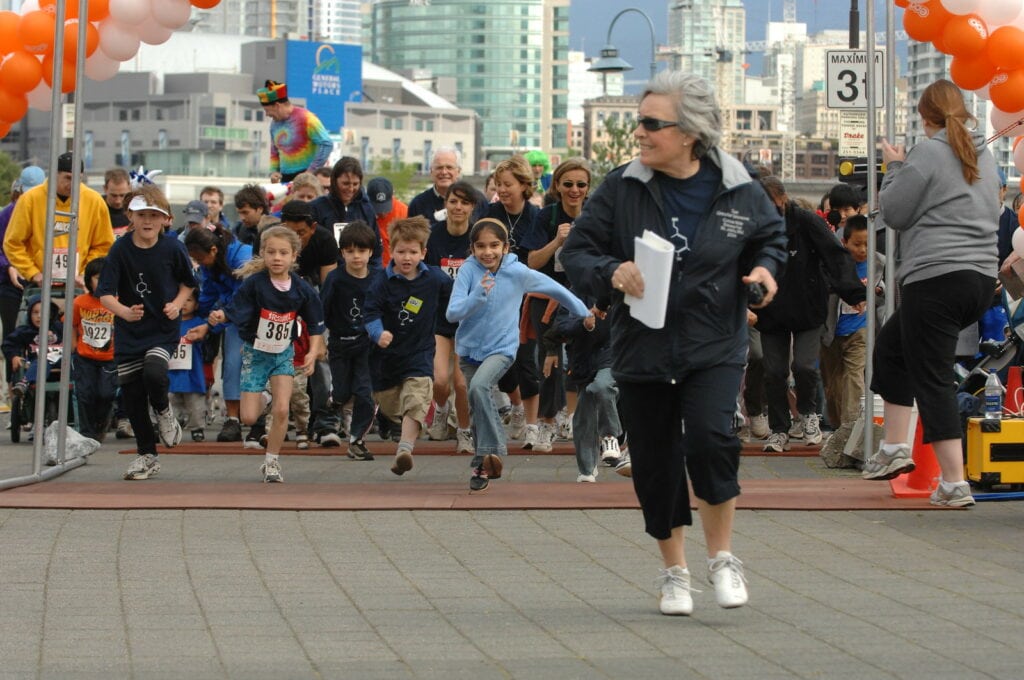
Patti leads the race at the 2007 Science Fair Fun Run. PHOTO: Science Fair Foundation BC
How to leave properly
The Science Fair Foundation BC continues to thrive, supporting science fair activity throughout the province.
That didn’t happen by accident. Patti planned her own succession carefully. A first transition attempt in 2010 didn’t hold, and she returned. After four more years of preparation, sending successors to the Canada-Wide and regional fairs across the country, enrolling them in accounting courses to ensure financial knowledge was transferred, and building a long-term partnership with the UBC Faculty of Science for venue and budget support for the GVRSF, a successful handover was completed in 2016. “It takes enthusiasm from one person,” she says, “a leader who then accumulates other people who agree with what you’re doing.”
Even in the years before that handover, she was still turning up as a learner. At the 2012 CWSF in Lethbridge, she encountered the Smarter Science framework for the first time. She came home and brought it back to BC. More than 30 years into her work, she was still finding things worth adopting.
For regions facing declining volunteer numbers and funding pressures, her advice is consistent: go find the alumni. Use technology to let people contribute remotely. But never sacrifice the fair itself. “That face-to-face event is critical. The Canada-Wide would not survive without that. The regional fairs will not survive without that.”
The Greater Vancouver Regional Science Fair is now run entirely by a volunteer committee with no paid staff. Almost every member of that committee is a science fair alumnus.
The aha moment
The impact of four decades is visible in the people who returned. Brian Remedios, who won gold at the very first GVRSF in 1983, credits the experience with teaching him how to market himself and his ideas. Dr. Clara Westwell-Roper went from a grade six science fair participant to MD/PhD, then returned to serve on the GVRSF organizing committee. Dr. Leonard Foster, now a YSC Board member, current chair of Science Fair Foundation BC, Chief Judge of GVRSF, and UBC professor, competed at six consecutive CWSFs starting in 1991. Devon Ross attended that same 1991 CWSF at UBC and is now a regional coordinator and BC middle school principal.
“The enthusiasm of the students, the support of their teachers and parents renews my reason for my involvement,” Patti reflects. What she returns to, again and again, is that moment of realization on a student’s face; the “aha moment.” “I get it, I really get it.”
Patti received the Order of British Columbia in 2010 and the federal Meritorious Service Medal in 2020 for her work as an educator and science fair advocate. In her 80s, she is still attending GVRSF planning meetings.
“Just a normal person,” she says when asked to describe herself. “An organizer, someone that gets things done, someone that likes life.”
The 2026 Canada-Wide Science Fair will be held in Edmonton from May 23–30 at the Edmonton EXPO Centre and the University of Alberta. Learn more at cwsf-espc.ca